Showing posts with label midwifery. Show all posts

Saturday, 28 March 2015

A week in the life

This week has been a very special week for me as an IM, and I was very honoured and privileged to receive third place in the BJM Community Midwife of the Year awards.

It was a spectacular evening hosted by the British Journal of Midwifery and a real highlight in the midwifery year; a time when midwives from all arenas can be acknowledged for all the hard work they do - and a wonderful opportunity to wash of the placenta and booby milk, get dressed up, and let our hair down!


Being an independent midwife is hard work; there is an awful lot that goes on behind the scenes and being on call 24/7 is not always easy.  It is however incredibly rewarding, and after heading up to collect my certificate on Monday night, I was reminded of some of the really hard times over the past few years when IMUK worked hard to retain independent midwifery and the right for women to choose.  During that time, I made a 'Week in the Life' video to use at an IMUK open day to highlight the work we do and the way we do it.  I am really pleased to share this video with you now:


I love being a midwife (mostly) and do feel very privileged to work in this way.  I am not sure that being on-call will be right for me forever, and I do grow weary of it at times.  However, I think that probably applies to many of the different midwifery avenues that are out there: any job that gives of yourself can lead to burn out and fatigue - which is why it is so important that we look after ourselves - and are looked after (Jeremy Hunt take note).

So thank you BJM for my award, thank you women for sharing your lives with me, and thank you to everyone who supported the campaign to save IM's and kept us going!

angela xx

"Midwives are best placed to make a real difference in the woman's overall experience - and I am privileged when I get invited in by the family to provide that care"
Angela Horler 

Wednesday, 6 March 2013

Independent Midwifery: Dispelling the Myths

"I bet your clients are really demanding?".  Sigh.  Nope, not usually.  In fact, I find the hardest bit of being an IM is dealing with such misconceptions and answering questions (from an NHS midwife) as that one.  I wrote previously about 'what we do', now however, it is time to dispel some myths about Independent Midwives (IM's):

IM's are Maverick and Risky
On the contrary; IM's have a large number of women who would be considered 'high risk' within the NHS and as such are seeking a midwife who will support them in their informed choices.  This means careful thought and planning, often involving a Supervisor of Midwives to help arrange the appropriate care.  It means being up-to-date with the latest research so that we can provide safe, effective practice.  There are risks to our job; but we work hard to keep these to a minimum whilst supporting women fully in their choices.

Women who use IM's are wealthy
Different women, from different backgrounds and with differing levels of personal income book with IM's.  Yes, I have had clients whose disposable income is enviable, however the vast majority of my clients have to work hard to find the money for my fees.  Or they simply can not find the money and then we try to work something out.  For most clients, their priority is to book with a midwife whom they know and trust  - and this often means making huge personal sacrifices.

IM's earn 'loads of money'
You can see that in the shiny 2005 Citroen Picasso I drive, and all the holidays I take - NOT!  Out of my fees I have to pay for my equipment, administration costs, petrol, training updates, tax, holiday 'pay' (being self-employed means when I am not working I am not earning), journal subscriptions,  etc etc.  IMs really do not earn huge sums - and we really do earn our money!  24-on call is not an 'easy' option and can take it's toll on family, friends and day-to-day life.

IM's Clients are demanding
If wanting to have one-to-one care with a midwife you know and trust, appointments in your own home, and feeling supported in your choices is considered 'demanding' then yep, my clients are very very demanding.  I do find however that this standard of care pays dividends in normal outcomes, high breastfeeding rates and family satisfaction.  And I always get tea and cake (hence my expanding waist line).  Women are really so demanding!

IM's don't want insurance
We do, we do, we do!  We just can't get it!  Honestly, every time you go to a birth, to hear the little voice on your shoulder saying 'this could be the one that costs your home' is not fun!  We do it because we can (not for much longer), we do it because we care, we do it because midwifery services should not be a 'one size fits all' option.  I do it for myself (terribly selfish), but knowing who I am going out to when I get called to a birth makes me feel like a safe practitioner.  Plus, I don't have to get to know the woman and her family, instead I can just offer my full attention and be 'with woman'.  It's fantastic.

Independent Midwifery is not for everyone, just as being a labour ward midwife, or a consultant midwife is not for everyone.  The important thing is that just as women should have choice, so too should midwives.  

There are many myths around Independent Midwifery and IM's, and the one that is most concerning is that is does not matter if we are no longer able to practice.  The demise of IMs will have catastrophic affects, and midwives within the NHS will find that their autonomy will be significantly threatened - the RCM know this and just continue to play footise with a government that is calling the shots.   Just look to countries where midwifery has been persecuted in this way, and then see how many midwives there are.  It is worrying.

Independent Midwifery must survive - and you can help.  You can share this blog with everyone and anyone who has an interest in midwifery or birth.  You can tell people the TRUTH about IM's.  You can watch 'Home Delivery' on March 21st and see how we work.  You can join our facebook page and learn more.  Women matter - IM's do too.

angela xx

Friday, 1 February 2013

Birth Works

There have been some awesome blogs this week from Midwives and from Women, as well as some interesting news headlines; I love reading blogs that inspire me, challenge me, and get more women and midwives thinking about birth and midwifery skills.

Last week I facilitated an 'Inspirational Birth' Study day, covering physiological birth: I have wanted to run this study day for a while, but when it came to planning the actual content for the day, I found myself procrastinating.  Fear in part; worry that I didn't know enough to fill a 6 hour day; concern that I wouldn't convey the message I was hoping too.....as it turned out it was a great day: I had forgotten actually just how much I have learnt in my journey as an Independent Midwife, and watching the 'light bulb' moments was very rewarding for me as a facilitator.  

In the current midwifery climate, there is little scope for physiological birth - and I don't state that lightly, as I know that is a direct criticism of maternity services.  How do I justify that statement?  Women are designed to give birth; sometimes, in some circumstances, some women may need some help (thank you Mary Cronk for that beautiful phrase), BUT we know that the vast majority of women are NOThaving normal, straightforward births - and even fewer are experiencing physiological birth  (there is a difference).  Birth Works, but it needs certain conditions, support and understanding for that to happen.  Maternity services in the UK are at breaking point: a rising birth rate and too few midwives (or cuts in services) means that women are not guaranteed one-to-one care in labour; women do not have time to build a relationship with a midwife that facilitates trust; hospitals have policies that are not conducive to physiological birth - but are conducive to intervention and time management; and midwives are not challenged on practise that is outdated and not evidence based (valsalva for one).

In my mind, there are a few issues that continue to confound and prevent change;

1. The demise of midwifery care outside of the NHS institution
2. The continued attack on women and midwives who choose to work with physiological birth
3. That we are no longer teaching our daughters to be feminists (a dirty word in modern society)

Take for example the Daily Mail article this week on women's experience of traumatic birth; then read the comments.  Women attacking women, men attacking women, women sharing very distressing experiences - and many comments indicating 'doctor knows best and women should be grateful' .

Birth is hard work; it is not perfect, sometimes it is not 'beautiful', sometimes it is down right mean; that is birth.  This is NOT however the 'care' that may be inflicted, the unkindness of medical staff or the paternalistic attitude of doctors.  What women want is a positive experience of birth - however that birth may unfold, and having a midwife by your side who understands, supports and believes in birth and whom the woman knows and trusts can make a huge difference to that experience.  That is not too much to ask.

Birth Works - but we have forgotten this.  Instead, we focus on the 'what if's', how to 'manage' birth, how to 'save' women from pain; we have lost trust in birth and have made hospitals and the NHS the saving grace of birth - as opposed to utilising it as and when is necessary - ensuring resources and first rate care are available for women who need it (I for one have been grateful for their expertise when women in my care have needed it).  We have also de-skilled midwives and on a global level we continue to allow midwifery to be quashed, undermined, de-valued and not recognised for the amazing profession it is.  Midwifery and women are controlled -  Freedom for Birth highlighted some of these issues.

Independent Midwifery has enabled me to hone and develop my skills in physiological birth; I already had the belief and passion for normal birth, but had to work very hard in my NHS training to fully experience it.  As an IM, I want to share my passion, my knowledge, my skills (and I still have much to learn and hopefully will never stop learning) - but come October my right to work as an IM will be outlawed - another blog to follow on that.  For now, I shall continue to work outside of the NHS, I shall continue to support physiological birth at every opportunity, and I will aim to inspire my own daughters to be proud to be a feminist.

Birth Works; Women Work; Midwifery Works.

angela xx


Tuesday, 1 January 2013

Looking to the future

2013 and the start of another year: I love the New Year; of feeling positive for the future, of letting go of the past, of seeking new goals and possibilities.

This time 14 years ago I was expecting my first baby..... and I was waiting for my first baby who was still to put in an appearance after my due date had been and gone!  I would still be waiting for another 6 days and my experience of midwifery care and birth was 'normal', but not great.  It took another two babies to understand that birth can be the single most transformational moment in a person's life, and during that powerful home birth, a midwife was also born, one who wanted to share the 'secret' with other women.  Roll on 9 years from that birth and here I am.........

In 2012 I cared for 10 birthing women and their families;  3 first time mothers (all normal births, 1 breech, 2 in hospital), 2 VBACS (1 a HWB, 1 ended in caesarean), 4 multips all having home water births and a water birth in the local birth centre on an NHS bank shift.  It was a privilege to care for these families and to support them through their inspiring births; the lack of alcohol is a pain and I wrote before about how up and down midwifery can feel, but it still never ceases to amaze me.  I'm not sure it ever will.

This year will be a testing year for Independent Midwives as we try to find a way forward with the looming PII issue and the EU laws preventing our practise from October 2013.  I have a busy case-load for the first half of this year, but feel confident and full of optimism that a solution will be found somehow, and I will be able to continue with my midwifery journey as I would like to in the second half of the year.   I also have plans to finish my book, to continue to work with aspiring midwives, to work to ensure IM's exist next year, and somewhere in between fit in my home-schooling family.  It won't be easy, but then 2012 challenged me in more ways than I ever felt possible, and I got through that! Just as in birth, sometimes it is harder than expected; transition can be frightening and overwhelming, but the hard work is worth it as you push your baby into the world.  This year I am looking forward to the birth of a new era in Midwifery and facing those challenges with the same excitement, hopes and fears as any new mother; I have a feeling it will be a year to remember.

angela xx

Thursday, 13 December 2012

Even a future Queen to be is still ‘just’ a Mother to Be.

The exciting news was announced that The Duke and Duchess of Cambridge are expecting their first baby; whilst the Duchess recovered from Hyperemesis Gravidarum (a debilitating acute from of morning sickness) and amidst all the excitement and media hype, was the devastating outcome of the ‘prank call’ and the everlasting ripples from the fall-out:  not the most positive start to a pregnancy for any couple, yet alone a couple who are prominently held in the public eye.

So what next for the Royal Couple? Well, just like any other new parents-to-be, before any of the screening, bloods, ultrasound, place of birth, type of birth choices they make, they might like to consider who they invite to care for them; they may choose to have their care with a private obstetrician, or they may choose to use their local NHS system, or they may seek a known midwife to support them in their pregnancy; but they do have a choice over all of these.   Essentially, having someone to talk to might make negotiating all those choices a little easier!

If I was Kate’s midwife (as her midwife, I would call her Kate, and she may call me Angela), I would spend time with her talking through her options; in-between appointments (that would be in her own home, and at convenient times, with appointment times that William could also come to) I would encourage her to read widely; some books I might suggest to her would include ‘Ina May's Guide to Childbirth’, Childbirth without Fear: The Principles and Practice of Natural Childbirth ’ and ‘What Every Parent Needs to Know: The incredible effects of love, nurture and play on your child's development’, as well as giving her up to date information on nutrition, screening and normal pregnancy ailments.   (I did google pregnancy books for Royalty, but it just found the Royal Free in Hampshire!)  We would drink tea together, share concerns, and build a trusting relationship, and she would feel secure in knowing that she would be well supported in her choices, and that on the big-day, someone she knew would be at her side when her baby was born.

This type of midwifery care enables women to really make choices; we also know that they are more likely to have a normal healthy pregnancy, a  normal straightforward birth, more likely to establish breastfeeding, and less likely to experience postnatal depression.   Pretty compelling reasons as to why one-to-one midwifery care is so important, and why it is essential that women know that this is the care they should receive as the norm, that they should be shouting loudly for, and that shouldn’t only be open to those whose NHS trust is forward thinking, or those who can engage an Independent Midwife like myself, and whose way of working is under threat.

The hype around the beginning of The Duke and Duchess’s pregnancy will hopefully settle and they will be able to look forward to the next 8 months or so (albeit it being very much the talk of the nation).   Expecting a baby, is for most people, a joyful, exciting event;  but every woman, whether it’s her first, second or subsequent baby, may still have the same anxieties, the same pregnancy complaints’ and may have to make some of the same choices that other mothers will – even if she is a future Queen!  

Tuesday, 23 October 2012

but that's just silly!......

Last week, and with my home-educating mummy hat on, I ran a 'morning with a midwife' workshop.  12 bright eyed children aged between 9 and 15 arrived at my home for a two-hour interactive workshop.

We started of by covering the role of the midwife, and what kind if checks we do; they played with my sonic aid and listened to each others hear rate; they guessed if one of the mum's BP would be high or low, and they giggled as they 'explored' their own pelvis - finding their coccyx and poking around their bottoms!

Children are brilliant (well mostly brilliant, unless they are annoying or I am having a bad day), but on the whole brilliant.  They see things so clearly, and haven't been dis-illusioned by adult-hood, and are still naturally thinking out-side the box - this, I am delighted to say, made teaching them great fun.

After they had labelled up some large pregnancy charts, we looked at the physiology of how the cervix opens, how the baby descends through the vagina and how the baby rotates and fits (perfectly) through the pelvis.  Having tired of the poor messages passed to children (and adults) about birth, I used positive language: I talked about the intensity of birth, and how women cope really well with this and can rest between surges, I talked about how the baby is squeezed and 'cuddled' by the uterus with every surge, I talked about how the baby is pushed out and it feels like a huge urge to pooh!  They got it, and accepted it, and asked about it, and then there was this Eureka! moment: to help the children visualise the size and weight of a growing baby, I had created a basket with different items weighing approx weights at different gestation.  I had an orange for 20 weeks (200gms) and so forth, with the final weight of the basket about 3200g (7 1/2 pounds ish in old money).  Using the pelvis, I showed how easy it was for the orange to get through when the 'mummy' was kneeling or on all fours, then I turned the pelvis into semi-recumbent and......... the Orange just sat there.  Eureka!  
..."but that is just silly!  why would you do that?!....."
asked a 9 year old.  Why would you do that?  Why would a woman give birth in the most physiologically challenging position you could choose? Why would a woman shut her pelvis and work against gravity?  Why would we do something so silly?  Well if a 9 year old can get that, then why are the vast majority of women giving birth on their backs?  Why are student midwives qualifying having NOT supported women in 'alternative' (don't get me started on that phrase) positions? Why why why? 


One for Mr Marr!


I feel there are many reasons (sadly) why this continues; the medical mode of birth, the use of pharmacological pain relief, ease for the midwife, the images of birth that are portrayed in the media?  None of these of course make it OK, or acceptable, but I do think the latter is a huge influencing factor. It's almost as if women expect to birth in that position - the children did, as that is what they have seen - until shown otherwise.  So perhaps then, it is the Film and TV producers of the world we should be talking to?  Certainly, in the opening issue of Andrew Marrs' History of the World (a brilliant programme I might add) the ancient African homosapien is seen to birth in the 'typical' semi-recumbent position.  Historically, women birthed upright; using trees, kneeling, squatting to give birth; not sitting with their bums and vagina's in the dirt.  It would have been much cooler Mr Marrs if your production team had shown that!

Perhaps it's time to remind ourselves of the Wonderful Female Pelvis, to remind women, doctors, parents, teachers, children, and the Film Industry of how perfectly designed we are to birth and how women - when well supported - will adopt the 'alternatively brilliant' birth positions that aid birth naturally.  Perhaps it's time for a new slogan:

'don't take it lying down!'..... 'knees for ease!......'using the (all) fours of gravity!......  suggestions please!

and here is a little something to share: (catch it here too http://www.youtube.com/watch?v=MswFqXdOq2U)

Enjoy!

angela xx

Monday, 15 October 2012

It's in the words

Two weeks ago, I took my three home-educated children along to the Science Museum to enjoy The Human Body film on their IMAX screen.  The film was really interesting, with lots of amazing facts, clever imagery and clear explanation.

Then, we get to the 'birth bit'; I am an experienced 'TV birth' avoider now, having wasted too much energy shouting at rubbish programmes (OBEM is right up there in my list of hates), so I tried not to get too excited, so as not to be disappointed   That was the right decision, as four-hundred children of varying ages were presented with the typical birth scene I strongly feel should not be broadcast: the woman, on her back, full epidural, stirrups, a team of people (I think they edited out what was clearly an assisted birth), baby taken away, wrapped and returned to the proud mother.  And the icing on the cake..... the midwives phrase that makes me want to want to jump up and down like a raving bloody looney (and that is being tame on what I really want to say):
"come on, push, push, push, push, push,....
get ANGRY (with your baby?)".
Get Angry?  Angry....... so is what we're really saying, is that we want the woman to be this:


and then expect to her be this:


A diametrical concept to the extreme.

And it's not just here that the language of midwifery needs addressing;  how many times do we need to remind women and midwives that pizzas are delivered, shopping is delivered, parcels are delivered.  Babies are BORN. I do not deliver babies; I facilitate birth, I support, I catch, I guide.  I am in awe as a woman delivers her own baby.  Not me.

To empower women, we need to think carefully about the language we use: midwives are in a very powerful position.  Women listen to us, they value us, they (hopefully) respect us: what we say and how we say it sticks.  Let's look at some other examples:
"ohh.... that's a big baby your growing there."  ( Woman hears "oohh, I ain't ever gonna get this baby out of my vagina.")
"would you like some pain-relief?"   (Woman hears "midwife thinks I can't cope; better get some drugs before this gets worse")
"just pop up here on the bed, there's a good girl"   (Woman hears "I better stay here where I am told")
In a recent issue of the Midirs Essentials, there was an interactive section encouraging the reader to reflect on some of the common phrases used and often said to women;  I, even as a student, have never told a women to get angry, have never asked a women to "take a deep breath and push", and have always encouraged women to listen to their body.  I have seen students swiftly adopt these 'standard phrases', as if these mantras somehow make them a midwife, a part of the 'gang', or somehow more competent in their mentors eyes?

As a midwife, my aim and hope is to empower a woman to feel like this:


because, I believe, that only when she has released her inner-lioness, only when she has birthed her baby (in her own unique way), only when she has felt that she did it (even with an assisted birth), that she is the woman, the mother, the strong-one, can I expect her to be this:


Words are powerful.  Women should be central to that power.

The most common way people give up their power is by thinking they don’t have any. – Alice Walker.

angela x


Tuesday, 2 October 2012

Choice?

Following the FFB Screening, I was going to write a blog about choice and choice for women, however The Mule has written a great blog piece on this, so I am not really feeling the need to re-write that.  So I started thinking about choice for midwives, and choice in midwifery.  Or lack of it.

When I started my midwifery journey, I entered it with this fierce passion and a strong belief that I was going to 'change midwifery services'.  Three years of training knocked most of that out of me, and moving into Independent Midwifery enabled me to start practising the 'midwifery' that I had read and  dreamed about.  My choice to be an Independent Midwife is under threat; insurance issues and EU rulings have seen to that, and within 12 months if there is not a solution found, it seems, that the only choice that may be open to me is to return to the NHS.

Apparently, as a registered Midwife, I am an autonomous practitioner; I am accountable for my actions, the advice I give, the women in my care; I have to maintain my knowledge base and demonstrate that I keep up-to-date; I have to attend study days that are relevant to my sphere of practice; I have to work a certain amount of clinical hours each year; and I have to keep up my registration (and pay my fees) with the NMC.  In short, in order to say 'I am a midwife', I have to work bloody hard at it!  And yet, and yet, my right to choose how to work is not being recognised.  The only midwifery (potentially) that will be 'legitimate' will be within the system of the NHS, and whilst there are amazing and wonderful NHS midwives out there, it's 'the system' that scares me.

So, what about being an autonomous practitioner?  Well, it seems that the rules that govern me as a midwife don't quite fit into the NHS system; I would not be free to choose my working hours; I would not be free to choose who I care for; I would not be free to choose the study days I attend (unless the 'off-duty' enables that); I would not be free to choose what I wear (please - tunics?  talk about putting a barrier between woman and midwife!); policies and protocols would dictate my practice - not the evidence and to support women in choices that would challenge these would, I fear, be a daily battle.    Burn-out in the NHS is high, midwives work long hours with little or no breaks, morale is low, staffing issues create stresses on midwives trying to juggle 2 -3 women at once. Choice?  I don't think so.

If women are going to get the care they deserve (based on the evidence and one-to-one care) and have the chance to 'reclaim birth' then it is essential that midwifery remains an autonomous profession, that midwives have the right to choose how they practice (remember, we are already well-governed), and that all maternity provision is not handed over to 'the system'.

Loosing Independent Midwifery will not just affect women; it has the potential to change midwifery in a way that I can not even bare to think about, it has the potential to remove the woman from the focus of care, and to remove any form of choice - whether that choice is a home-birth, an epidural, a caesarean section..........

What can you do about it?  Tell every woman, every person, everybody that you talk to about Independent Midwives; share this page on facebook, email to it to 10 people you know, and ask them to forward it to another 10 people, and another 10 people, and another 10......  tell them about the brilliant NHS midwives who cared for you, who held your hand, and then tell them that if Independent Midwives disappear, so too might that midwife who 'was so lovely' to you.  Because, if you don't tell people, and we disappear, the real tragedy will be that one day, choice will simply not exist for women or for midwives.

A young girl was walking along a beach upon which thousands of starfish had been washed up during a terrible storm. When she came to each starfish, she would pick it up, and throw it back into the ocean. People watched her with amusement.
 
She had been doing this for some time when a man approached her and said, “Little girl, why are you doing this? Look at this beach! You can’t save all these starfish. You can’t begin to make a difference!”
 
The girl seemed crushed, suddenly deflated. But after a few moments, she bent down, picked up another starfish, and hurled it as far as she could into the ocean. Then she looked up at the man and replied,
 
“Well, I made a difference to that one!”


Sunday, 9 September 2012

Tea & Knitting

This week there has been a lot of poor journalism around a maternal death following a home birth.  There have also been a lot of opinions about where women 'should' give birth, safety of birth, midwives and so forth.  It tires me; the questions we should be asking are how can we best support women who do not wish to give birth a clinical environment, and how can we best support midwives to enable this.

However, I fear these debates will just go on and on, so for now, I have decided to focus on something a little more positive; the art of knitting......

I have (slowly) been catching up with some of my midwifery reading; I subscribe to various journals, and one of my favourites is the ARM 'Midwifery Matters' journal.

In the Summer 2012 issue, there was a synopsis of the on-line debate on the ARM forum regarding Knitting, and whether is was acceptable for midwives to knit at births.  Sadly, some HoM's did not feel it appropriate for midwives to knit at births, and midwives have been informed that it is 'unprofessional'.

The late and very gifted Tricia Anderson spoke and wrote about the art of 'drinking tea intelligently', a phrase which highlights how midwives may appear to be doing very little, but are in fact intuitively, patiently, quietly, observing and listening to the mother as her labour unfolds.

Midwifery is an 'art and a science': one midwifery skill that is undervalued (I feel) is the art of recognising where a women may be in her labour from her body language, the sounds she makes and  the positions she adopts - not from a vaginal examination to asses what her cervix is doing.  When a midwife is quietly present in the back ground, she sends a strong message to the mother: "I am here, you are safe, all is well."  The quiet midwife can recognise when a little more support might be needed and welcomed; gentle massage on the mothers back or on her sacrum, a calmly spoken word of encouragement, the passing of a cold flannel to cool her face.  Sometimes, these actions need to be directed to the father, who is doing a wonderful job, but who may also need reassurance and encouragement.

I recall visiting a labour ward not too long ago to drop some samples; I was welcomed by a young, newly qualified midwife who was sat at the reception desk.  From one of the labour rooms, I heard the distinct sounds of a women who was labouring strongly, who was working beautifully with her body, and who was clearly pushing spontaneously as the strong surges urged her to bare down.  The midwife, in her smart crisp uniform and shiney bright name badge called to her colleague; "do you think that women is fully?  maybe we should go in and check (VE) her."  Slowly, another midwife took it on herself to see to the woman, who was alone with her partner.  At that moment, I feel such a deep sadness: I felt sad that this midwife could not clearly recognise the sounds of labour, that the woman did not have a midwife by her side, and that our 'professionalism' was represented by a uniform sat at a desk.

So back to knitting; I loved the response in the forum from Linda Wylie, a Midwifery Lecturer in Paisley who posted:
"I take a session with my student midwives in which my opening gambit is - today we are going to learn to knit.  I then go on to talk about masterly inactivity as described my Mary Cronk."
Perhaps, if this was a compulsory part of midwifery training for all students, we would have more midwives qualifying who were confident to keep their hands busy and off the woman; who were tuned into the sounds of women and their labour, who felt content to sit quietly in the back ground (and not the midwives station?) and who understood the significance of 'drinking tea intelligently'.

I decided a couple of years ago that I needed to learn to knit.  I was content to sit in the background at a birth, but knitting engages the mind in a gentle repetitive activity.  Knitting is easily transferable.  You can pick it up.  Put it down.  Stop if its annoying the woman.  Start if you need to keep your hands busy.  And all the great midwives knit (in my romantic mind anyway).  Knitting reminds me of the wise women, the elders of the community sharing their skills and knowledge with the younger women; it reminds me of a time when we slowed a little, and it reminds me of my time at The Farm (with other amazing midwives and Ina May Gaskin) where we spent time together creating crafts and remembering the ways of women.

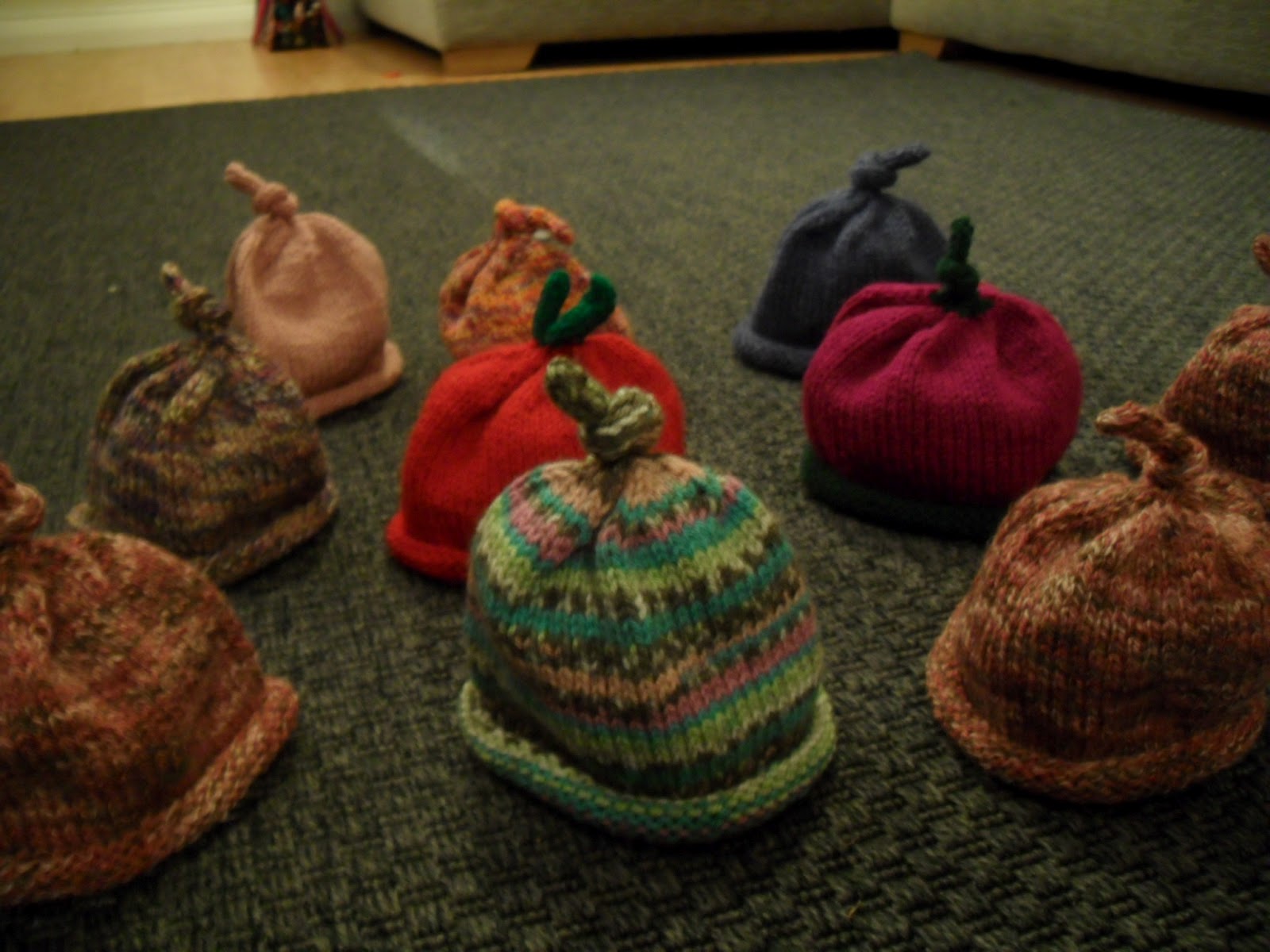
So I knit; I've knitted bags, flowers, tea cosies, scarf's, animals to name a few.  But mostly, I knit baby hats; these are simple, require no pattern, and are a gorgeous gift to give to the new mother for her new baby who has arrived earth-side.

Hats!

Tomato Hat


So I urge you fellow midwives, student midwives and aspiring midwives to take up your needles and start a (quiet) revolution.

Knitting is very conducive to thought.  It is nice to knit a while, put down the needles, write a while, then take up the sock again.  ~Dorothy Day

Happy knitting!

Midwife angela 


Monday, 20 August 2012

What we do.....

I was thinking about the question "what do you do then?" in response to IM's not reflecting some of the midwives seen on current TV programmes.  Taking time to reflect on that question, I realised its more what we DON'T do.....

  • We don't tell women what they should or should not do; we explore, discuss, share and come to a (mutually made) 'trusting' decision.
  • We don't subject women to unnecessary intervention such as routine VE's, ARM's, directive pushing or managed 3rd stage.
  • We don't assume we know best simply because we are the 'professional'; women know their minds, bodies and babies.  We learn as much from them as they from us.
  • We don't apply time frames to labour and birth; we wait respectfully, 'drink tea intelligently' (Anderson) and gently support birth as it unfolds.  We do not (on the whole) need to hasten this process.
  • We don't  'normalise the abnormal'; we approach every woman, every pregnancy and every birth as an event that is 'uniquely normal', working with evidence based practice, within our midwives rules and code of conduct, and in the woman's best interest

Angela xx

Saturday, 19 May 2012

'Holding the space' & emotional strength

When you are invited to attend a birth, you are honoured to be supporting a woman at an immensely important time in her life.  As a midwife, the energy that you bring into the room during the labour and birth is really important, as you need to be able to 'hold' the space around the woman so that she can labour with minimum disruption and in her own time.  This ability to 'hold a space' requires a great deal of emotional strength; trust; patience and the ability to sit on one's hands.  This is being 'with woman'.

In March, my mother died, and the recent months have been difficult for me.  Aside to the loss of my mother, I am learning to support my daughter who is Aspergers, learning 'how' to home educate two of my children (!), dealing with a teenage daughter...... and still wanting to be the absolute best midwife I can be.

Something has to give, and for a little while that will be my midwifery.  I am taking a short 6-month sabbatical so that I can grieve, heal, rest, learn, and support my family.  Only then, when I have taken care of myself, can I return to supporting women as they journey to meeting their baby and be the midwife I aspire to be.

Angela x

Sunday, 13 November 2011

Baby your a Firework!

This week has been incredibly busy with bookings and enquiries; must be something in the water! I was also privileged to attend a home water birth on Bon Fire Night. Instead of watching the local fireworks display, a beautiful little girl entered the world very quickly and swiftly much to her parents surprise and delight; this time we did make it into the pool but only just!

Welcome to the world baby girl.

Angela x

Saturday, 15 October 2011

The Art of Waiting.... (patiently)

There are many skills that a midwife needs to acquire, but the one that has perhaps challenged me most is the art of Waiting..... and waiting..... and occasionally waiting even more! This is what I have learnt:


  1. A watched kettle (bump) never boils

  2. 'Switching off' is essential in order to lead a 'normal' life on call

  3. Projects are a great way of distracting the mind

  4. Family and friends have to be 110% understanding

  5. It's worth the wait


Currently I am waiting for a friends baby, whilst my family are enjoying the last of the sunshine at the coast; a planned short break, but of course baby has other plans! My house is now incredibly tidy; the washing is up to date; the gardening is done; my hair has been cut; I have spent some gift vouchers that I received in July; my knitting project is well under way........ and I am still waiting. 'Tis the life of a midwife - and one I wouldn't change!
Angela x

Monday, 13 June 2011

Where is the love?.....

Having recently spent some time in various NHS trusts, I am always amazed by several things:

1) The varying ways in which Independent Midwives are treated
2) The amazing work that NHS colleagues do in sometimes really difficult situations
and the saddest part
3) There is no LOVE in most units :-(

Having a baby for most women is a unique, life-changing event; they are facing the biggest challenge they may ever face in becoming a parent. Some women face this with confidence and ease, some in-difference and some complete terror; but all of these women deserve some patience, empathy and LOVE!

I can not begin to imagine how hard it must be to work full-time on a busy labour ward. I feel it is time that midwives are taken care of properly, with respect from management and team members, with love and care. Then they too can pass that on to the women and families that are central to midwifery care!

Angela

Wednesday, 11 November 2009

Is having a home birth selfish?

This was a question posted on the popular 'Mumsnet' website and caused a lot of response. I have thought about this question a lot (insomnia gives you time to think!), and I guess my response to that would be that there are many decisions we have to make as parents that are life changing, for example:
  • is it selfish to vaccinate / not-vaccinate?
  • is it selfish to place a child in full-time nursery care / be a full-time parent?
  • is it selfish to home-educate / use state schooling?
  • is it selfish to have one child / have 4+ children?

All of the decisions we make as parents are difficult ones: all we can hope to do is make the best decision, based on the information and evidence we have, at that time. Choosing to give birth at home does involve risks, but so does choosing to give birth in hospital and contrary to popular belief; hospital does not guarantee a safe outcome.

Planning a home birth based on the evidence available, is shown to be a safe, normal choice and is nothing new; Women have birthed, and will continue to birth in the place that feels right for them. The question of being selfish is therefore an unnecessary and judgemental one to pose. We are all individuals who have to make choices - as with the examples above they may not be the same choices that other parents may make, but they are no less valuable or 'right'. Birth and parenting is not 'black & white' but is made up of many shades, and every day brings new challenges and choices. I know I don't always get it right, but when it comes to important, life influencing decisions, I try to make the best decision I can at that time!

Selfishness aside, having a baby is a unique, life-changing experience; for some women they will need all the interventions that high-tech birth can offer, for some women they will choose to give birth in their local hospital, and for some women they will choose to give birth in the comfort of their own home. All choices should be respected, all women should receive the best care they can, and all women should feel supported in the decision they have made, rather than bullied, coerced or belittled into doing something that is not right for them.