Showing posts with label art of midwifery. Show all posts

Monday, 23 February 2015

Sharing the Skills: The Pinard

I have two expectations when a student comes to spend some time with me:

1. That they have read Ina May

2. That they are prepared to learn how to use a Pinard (if they are not already practised)

When we think of all the technological advancements that have been made in pregnancy and childbirth, it is often assumed that the beautiful Pinard Trumpet is better placed way back in the 'olden times', but this little piece of midwifery equipment is (and should be) a staple part of midwifery practise - where-ever that is taking place.

Firstly, lets look at what National Guidance says about the Pinard: intermittent auscultation is the national recommendation for the 'low-risk' (that's another blog in itself) woman in labour.  In these guidelines it recommends the use of a Pinard or a doppler (sonic-aid).  It also states that when there is a concern with a low base-rate foetal heart on continuous monitoring, it is important to ascertain that it is not the maternal heart that is being recorded.  The Pinard is essential in that clinical scenario is you can not pick-up the maternal hear beat when using one.  So, the expectation is that a midwife should know how to use a Pinard.

Secondly, let us think about the routine use of a doppler (sonic-aid) to auscultate the baby's heart rate.  The little sonic-aid is a wondrous invention; it enables midwives to hear that rhythmical heart rate, reassuring that all is well, and enables parents to hear their baby's heart from very early in pregnancy.  I always find it completely heart-melting the first time parents hear that sound and they are full of bare emotion.  BUT, when we use a doppler, we send a high-wave frequency through the uterus that resonates with the baby (again, that's another blog post).  Although National Guidance no longer recommends routine auscultation at an antenatal appointment, many mothers find this a reassuring and exciting element of their care.  Around 2 years ago, as I reflected on my birth statistics, I realised that I had a relatively high number of 'compound presentation' births (this is where the baby is born with it's hands' up by its head).  Whilst this is not usually a problem, it can sometimes make birth a little longer or potentially cause more perineal trauma for mum.  I pondered
A foetoscope
on this for a while, and recalled a very wise, older midwife once saying that she felt we had more compound presentations since the introduction of routine sonic-aid use, and perhaps the baby's were "'covering their ears from the high frequency sound".  So I started my own little trial and I no longer use the sonic-aid in the last trimester or pregnancy: instead I show the women my little Pinard (they love it!) and use a foetoscope (see picture) so that they too can listen to their baby.  And yes, in that time I have had NO babies with hands up by their heads.  Maybe a coincidence?  But one I am not tempted to test!

How to use a Pinard
You can only really use a Pinard or fetoscope successfully from around 28 weeks of pregnancy - before this the baby is just too small and you have to place the Pinard directly over the baby's heart or shoulder, so you need to be able to palpate where the baby is lying.  Antenatally, its relatively easy to use once you've become skilled at palpation and 'listening', so as a student midwife this is the best time to hone your skills!  It is usually easier to start with a plastic Pinard and progress to a wooden one.  The ARM sell beautiful beech Pinards.

Using a pinard in labour can however be a little trickier -especially if the woman is planning to use water in labour, unless you are prepared to wear a get-up like this!   The expectation will be for the woman to lift her bump in and out of the water which can be very disruptive to the flow of her labour!  A water-proof sonic aid is a God-send as you can easily monitor her baby's well-being and work around her by reaching down into the pool and under her bump as unobtrusively as possible.


Sara Wickham has written a lovely explanation on how to use a Pinard (saves me re-writing it!) and Kay Hardie, from Kent Independent Midwives has made an excellent you-tube video on how to use a Pinard.  Read and watch to learn - and then practice, practice practice until you are confident and able to use one!


The Pinard Trumpet may be an 'old fashioned' peice of equipment, but its place is just as relevant in 21st century midwifery as it ever was.  What do you think?


 angela xx

"Knowledge is of no value unless you put it into practice."
Anton Chekov 

Wednesday, 22 January 2014

Sharing the Skills: Supporting birth without the use of vaginal examinations

I have struggled to write this particular post for the past week or so; do I reference, don't I reference. Am I trying to be the 'expert'?  Is this formal, informal.  Argh - round and round I go!  Until a colleague reminded me this is a BLOG post, meaning it's an informal piece of my opinion (see disclaimer thingy).    and breathe........

I can still remember the first Vaginal Examination (VE) I preformed as a student midwife.  I remember two things mainly:

1. I had no idea what on earth I was feeling!

2. That this was a very invasive procedure.

Many units have a 4-hour guideline for VEs to asses the progress of labour; this routine assessment has no real evidence to support it and is still of unproven value in routine midwifery care, despite being recommended by NICE (it is important to acknowledge, that NICE states women should be offered a VE).  VE's can be a very helpful tool in understanding a labour when perhaps midwifery intervention may support the woman in keeping her labour normal, when clarity around labour progress is appropriate, and / or if it will affect the plan of care.  When used as the marker for progress in labour only, VEs can cloud the midwives understanding of what is happening in the woman's birth story and cause the woman to doubt her own body.

The art of Midwifery is the 'big picture', and it is through many different signs that a midwife may recognise where a woman is in her labour.  This awareness is not 'taught', but learnt: learnt from the women as you observe undisturbed birth, learnt from sitting and quietly absorbing the behaviours unfolding in front of you, and learnt from not starting from a place of 'knowing best'.  As a result of this, the thoughts below are not a 'check list' of progress in labour, simply prompts to help you consider the physiology of what may be unfolding before you.  Remember also that all women are different, and every woman and birth can unfold in a way that is unique for them.

Let us consider then, alternative ways of recognising a labour that is progressing:

How low can you go?
When I was a student midwife, I heard the wonderful Jane Evans speak on Breech birth.  In her talk, she described how women get 'closer the the ground' as their labour progressed.  In labour, as those powerful surges increase in intensity, the woman finds it harder to be upright and conserves her energy by moving into positions that bring her down - usually into the all fours, or leaning over a sofa etc.  As a guide, the closer she is to the ground and needs to stay 'grounded', the further along in her labour she is likely to be.

Those wonderful noises
Experienced midwives can often tell where a women is in a labour from those lovely noises she omits; Liz Nightingale wrote an excellent article in Midirs on noises in labour which is well worth getting your hands on. Women, under the influence of Oxytocin in labour, start to withdraw into themselves.  Talking and conversation dwindles (and so too should birth workers!), but the woman will naturally start to moan and groan through those surges; those noises come from deep within her and she has little control over them.

The 'purple' line
If you google this term you will find lots of excellent blogs reflecting on this phenomena, pictures on what you may see and so forth.  My favourite post is in Birth Without Fear which is beautifully written: just read that for a great explanation on the purple line.  I love the purple line; once you recognise it you can't fail to notice it.  Just wish bottoms came with a little gauge - you know, when it's this height the cervix is x-cms etc!

This is a woman who smiled
most of the way through her labour!
Sense of humour failure
When the woman is no longer smiling, then we are in serious business (except for those women who are having serene, orgasmic births - they smile a lot).  Humour can really help a woman in labour as it can ease tension.  If you follow her guide however, the more serious she becomes the less she may appreciate wise-crack jokes from her supporters, and the more likely her labour is advancing well.


It's all a bit sticky down here
Around 8-9 cms, women will discharge a sticky, blood-stained mucousy plug as the cervix really opens. Yay!  Even better still, as the cervix becomes fully open, the waters will spontaneously release if they have not done so already.  There is NO NEED to do an ARM if a women is 9 cms and membranes are intact (and yes I have seen midwives do this, because otherwise how will the baby get out?).

Cold Feet
As the uterus continues to work beautifully, the blood circulation will move more and more towards to uterus: this is why women get cold feet as labour progresses.  A German midwife (when I was a student) also taught me that the heat will move 'up the woman's' legs.  At around 5 cms, the heat will start from just above her knees, 8 cms the thighs feel cold, at 9cms, only a small amount of heat is left at the top of her thighs.  We used to have guessing games by gently placing a hand on the woman's thighs to see 'where she was'.  It doesn't always work, but is gentle and non-invasive.  Use the back of your hand to gently asses the coolness of the legs.

Pushing on through
Why, oh why, oh why on earth do some midwives feel the need to 'confirm' the onset of second stage with a VE?  Really?  As a woman moves into second stage, she will start to make grunting / expulsive noises.  These will intensify as the baby moves further down, triggering further expulsive urges.  The woman's body will start to 'open' as the rhombus lifts.  The purple line will be highly visible and prominent.  She will probably poop.  All of this will happen either quickly (as with the foetal ejection reflex), or for the vast majority of women, s-l-o-w-l-y!  Women can tell when they are 'moving' their baby and will often remark they can feel the baby moving down.  If after a period of time of strong expulsive urges, there are no external signs of descent, then a VE may be appropriate.  That time depends on the whole clinical picture.  And No, 10 minutes is not long enough.


There are many other ways of recognising progress in labour without the use of VEs (and please do share them); these are the ones I use to help me recognise that labour is progressing without needing me to 'do' anything other then keep the mother and baby safe and hold the space for the birth.  Observing the woman in a non-invasive way (i.e. not staring at her and 'drinking tea intelligently') normally enables the midwife to sense if something is not 'quite' right and provide the appropriate care to help the mother birth her baby as she needs to.  And this is usually herself.

Midwife angela 

“There is no other organ quite like the uterus. If men had such an organ they would brag about it. So should we” ― Ina May Gaskin


Wednesday, 23 October 2013

Sharing the knowledge: let us begin.

Midwifery is one of those professions where you develop your skills over time; always learning, always discovering something new, remembering something forgotten, and gleaning knowledge from many sources.

To qualify as a midwife in the UK, you undertake a 3 year full-time course, with a roughly 50% split of theory and practice (practice taking place within the NHS).  You learn drills, you read books, write essays, 'deliver' babies, watch caesarean sections, 'help' women to breastfeed and 'learn' the day-to-day skills of midwifery in the NHS.  This is normally under the watchful eye of a mentor, an experienced midwife who guides you along the way (assuming of course there is not a huge theory-practice gap with what that mentor is teaching you).

Throughout my 3 years as a student I learnt huge amounts, but (as with most professions) many of the skills I have learnt have come with the experience of serving women in childbirth, watching women labour in their own environment without the time constraints of unit policies, and learning to trust even more that the less I 'do', the better the outcome*.  Much of this knowledge was not 'taught' in my training and I believe there is such a strong culture of fear around childbirth, that we tie ourselves up in knots to address unit policies, many of which are not based on the evidence.

So how do we share and spread that innate midwifery knowledge that respects women and the natural process of childbirth, when the practice we are exposed to within the training may (or may not) often sit within the medical mode of childbirth.  How do we give student midwives and newly qualified midwives a glimpse into a different way of approaching birth?  I believe we need to be writing about it, shouting about it, talking about it, and sharing, sharing, sharing.  Of course, this then exposes us to the risk or being 'ridiculed', or worse, intensively scrutinised in our practice; this then moves this innate knowledge back into the 'secret' side of midwifery, and does not enable policies (such as arbitrary time limits in the 2nd stage of labour) to be challenged.

I am planning to 'put myself out there' a bit and start to write about skills and ideas, such as:

  • confirming the onset of labour without vaginal examinations
  • assessing labour progress without vaginal examinations
  • auscultation using a Pinnards or fetoscope
  • facilitating spontaneous 2nd stage without directing women on 'how' to push
  • water birth
  • physiological 3rd stage
  • the effects of energy on the labouring woman
  • assisting a woman with a mal-positioned baby


I invite questions or suggestions for topics, and I am inviting guest blogging midwives to share their knowledge too.  Along with this I also need to add in that 'disclaimer'; that is to say that I am not saying this is the only way to practice, or that it is always appropriate to the woman you are caring for, or that it will sit easily within the trust you may be working within.

I do hope you will enjoy these blogs, and and share and talk about skills with your colleagues, and ultimately develop your own practice in a way that keeps the woman and the process of normal birth central to your care.

Enjoy
angela x

*doing less is of course not to ignore a woman whose labour is changing and will perhaps require help in another way.

“Be the change that you wish to see in the world.”― Mahatma Gandhi


Monday, 29 October 2012

Shhh..... I practise physiological third stage

The third stage of labour feels like a topic that is discussed in secret amongst student midwives and midwives; whispered 'what do you do?' questions and the caginess around what one actually 'does' is tangible.

Practice around third stage came up in a recent conversation I was having, and I felt it was time this subject was explored, caginess put aside, and clarity about the NORMALness of a physiological third stage heralded high and loud.

As a student midwife, I was clear about the skills I wanted to learn; I was also very fortunate to have a mentor who was skilled in facilitating physiological birth, and another mentor whose trust in me enabled us to learn together about the third stage.  I was, however, unique in being one of only a handful of students who qualified having gained this knowledge and developed this skill: most only knew how to 'manage' the delivery of the placenta.  I know this is still happening and frankly I find it worrying.

It is normal within the hospital setting for managed third stage to occur; a reason cited to me is that it takes 'too long' to wait for the placenta.

Q1. How long does a physiological third stage take? 
20 minutes is about average, maybe 30, very rarely an hour or more.  If you assume it will take around 20 minutes, even in a busy unit, this should still be the time that the mother and baby are bonding and shouldn't be 'hassled'.  Plenty of time therefore for the midwife to be quietly and attentively watching.
 Q2.  What about the risk of haemorrhage?
Firstly, in a physiological birth, the risk of haemorrhage is relatively low  (I could reference this, but am choosing to use innate midwifery knowledge here).  The clue in this statement is physiological birth, i.e. spontaneous onset, contractions regular and rhythmic, no pharmacological pain relief (okay, a little gas and air is fine), spontaneous explusive urges, no interference with the mother-baby dyad.  In other words, with absolutely no intervention - just a mother working with her body, oxytocin flowing, adrenalin reduced, trust and patience high. 

Okay, so it doesn't take as long as you might have thought, and mum might not bleed to death, but what about the shift leader who is knocking on the door asking if the placenta is out?  What about the assumption from the woman that she will have the injection?  If the shift leader is knocking, it is our job as midwives to politely, but firmly inform them that we will let them know if we have any concerns, we will update them as and when is appropriate, but will not accept people knocking on the door (you could point out that this is like trying to have a pooh with people hanging around outside, and maybe they would not be comfortable with that?).  Midwifery is an autonomous profession, you have a duty of care to the woman, not the shift leader.

Q3. What about informed choice?
It is currently bang on trend for women to choose 'delayed cord clamping'; therefore half the work is done for you.  You know the benefits of a physiological third stage - if you have supported her in a physiological birth, surely you are just continuing with that?  I'm going to put my neck out here and say why does she need to make a choice?  That would mean you are questioning her body, and getting her thinking brain to respond.  Remember, at this point its all about the oxytocin - and quiet, watchful waiting.
 In The Midwife's Labour and Birth Handbook there is a very good chapter on third stage and a clear explanation of what a midwife 'should' and 'shouldn't' be doing; Elizabeth Davis also offers a clear summary in her beautiful Heart and Hands: A Midwife's Guide to Pregnancy and Birth book (definitely recommend that one).

Q4. What do you do?
I myself have learnt FIVE key skills to supporting a physiological third stage :
1. Keep the woman warm after birth: if she is cold, it affects the physiology of the placental separation
2. Keep the room quiet: too much excitement raises adrenaline and impacts on uterine contractions
3.  Watch carefully and listen fully: you will see the tell-tale trickle of separation and mum normally notices stomach pains
4.  Use gravity to aid delivery: the mother will normally push the placena out herself.  However, toilets are magical here; help the mother to the loo, she will pee and pass the placenta all at once.  Never fails if time is passing! 
5. Do not Fear it - IT WORKS!

“Nothing in life is to be feared. It is only to be understood. “~Marie Curie

What thoughts do you have to share around the third stage?

angela xx


Sunday, 9 September 2012

Tea & Knitting

This week there has been a lot of poor journalism around a maternal death following a home birth.  There have also been a lot of opinions about where women 'should' give birth, safety of birth, midwives and so forth.  It tires me; the questions we should be asking are how can we best support women who do not wish to give birth a clinical environment, and how can we best support midwives to enable this.

However, I fear these debates will just go on and on, so for now, I have decided to focus on something a little more positive; the art of knitting......

I have (slowly) been catching up with some of my midwifery reading; I subscribe to various journals, and one of my favourites is the ARM 'Midwifery Matters' journal.

In the Summer 2012 issue, there was a synopsis of the on-line debate on the ARM forum regarding Knitting, and whether is was acceptable for midwives to knit at births.  Sadly, some HoM's did not feel it appropriate for midwives to knit at births, and midwives have been informed that it is 'unprofessional'.

The late and very gifted Tricia Anderson spoke and wrote about the art of 'drinking tea intelligently', a phrase which highlights how midwives may appear to be doing very little, but are in fact intuitively, patiently, quietly, observing and listening to the mother as her labour unfolds.

Midwifery is an 'art and a science': one midwifery skill that is undervalued (I feel) is the art of recognising where a women may be in her labour from her body language, the sounds she makes and  the positions she adopts - not from a vaginal examination to asses what her cervix is doing.  When a midwife is quietly present in the back ground, she sends a strong message to the mother: "I am here, you are safe, all is well."  The quiet midwife can recognise when a little more support might be needed and welcomed; gentle massage on the mothers back or on her sacrum, a calmly spoken word of encouragement, the passing of a cold flannel to cool her face.  Sometimes, these actions need to be directed to the father, who is doing a wonderful job, but who may also need reassurance and encouragement.

I recall visiting a labour ward not too long ago to drop some samples; I was welcomed by a young, newly qualified midwife who was sat at the reception desk.  From one of the labour rooms, I heard the distinct sounds of a women who was labouring strongly, who was working beautifully with her body, and who was clearly pushing spontaneously as the strong surges urged her to bare down.  The midwife, in her smart crisp uniform and shiney bright name badge called to her colleague; "do you think that women is fully?  maybe we should go in and check (VE) her."  Slowly, another midwife took it on herself to see to the woman, who was alone with her partner.  At that moment, I feel such a deep sadness: I felt sad that this midwife could not clearly recognise the sounds of labour, that the woman did not have a midwife by her side, and that our 'professionalism' was represented by a uniform sat at a desk.

So back to knitting; I loved the response in the forum from Linda Wylie, a Midwifery Lecturer in Paisley who posted:
"I take a session with my student midwives in which my opening gambit is - today we are going to learn to knit.  I then go on to talk about masterly inactivity as described my Mary Cronk."
Perhaps, if this was a compulsory part of midwifery training for all students, we would have more midwives qualifying who were confident to keep their hands busy and off the woman; who were tuned into the sounds of women and their labour, who felt content to sit quietly in the back ground (and not the midwives station?) and who understood the significance of 'drinking tea intelligently'.

I decided a couple of years ago that I needed to learn to knit.  I was content to sit in the background at a birth, but knitting engages the mind in a gentle repetitive activity.  Knitting is easily transferable.  You can pick it up.  Put it down.  Stop if its annoying the woman.  Start if you need to keep your hands busy.  And all the great midwives knit (in my romantic mind anyway).  Knitting reminds me of the wise women, the elders of the community sharing their skills and knowledge with the younger women; it reminds me of a time when we slowed a little, and it reminds me of my time at The Farm (with other amazing midwives and Ina May Gaskin) where we spent time together creating crafts and remembering the ways of women.

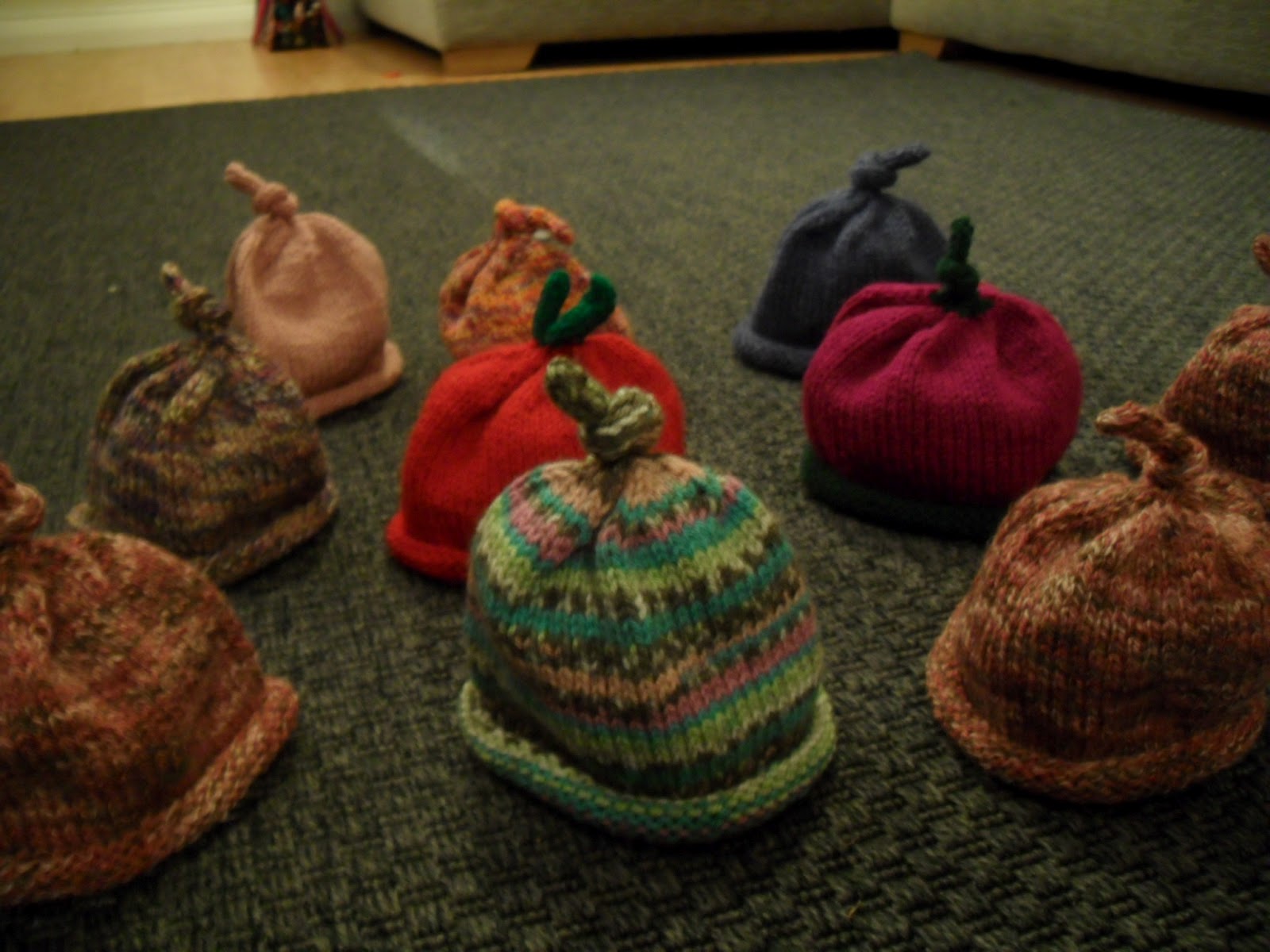
So I knit; I've knitted bags, flowers, tea cosies, scarf's, animals to name a few.  But mostly, I knit baby hats; these are simple, require no pattern, and are a gorgeous gift to give to the new mother for her new baby who has arrived earth-side.

Hats!

Tomato Hat


So I urge you fellow midwives, student midwives and aspiring midwives to take up your needles and start a (quiet) revolution.

Knitting is very conducive to thought.  It is nice to knit a while, put down the needles, write a while, then take up the sock again.  ~Dorothy Day

Happy knitting!

Midwife angela