Monday, 29 October 2012

Shhh..... I practise physiological third stage

The third stage of labour feels like a topic that is discussed in secret amongst student midwives and midwives; whispered 'what do you do?' questions and the caginess around what one actually 'does' is tangible.

Practice around third stage came up in a recent conversation I was having, and I felt it was time this subject was explored, caginess put aside, and clarity about the NORMALness of a physiological third stage heralded high and loud.

As a student midwife, I was clear about the skills I wanted to learn; I was also very fortunate to have a mentor who was skilled in facilitating physiological birth, and another mentor whose trust in me enabled us to learn together about the third stage.  I was, however, unique in being one of only a handful of students who qualified having gained this knowledge and developed this skill: most only knew how to 'manage' the delivery of the placenta.  I know this is still happening and frankly I find it worrying.

It is normal within the hospital setting for managed third stage to occur; a reason cited to me is that it takes 'too long' to wait for the placenta.

Q1. How long does a physiological third stage take? 
20 minutes is about average, maybe 30, very rarely an hour or more.  If you assume it will take around 20 minutes, even in a busy unit, this should still be the time that the mother and baby are bonding and shouldn't be 'hassled'.  Plenty of time therefore for the midwife to be quietly and attentively watching.
 Q2.  What about the risk of haemorrhage?
Firstly, in a physiological birth, the risk of haemorrhage is relatively low  (I could reference this, but am choosing to use innate midwifery knowledge here).  The clue in this statement is physiological birth, i.e. spontaneous onset, contractions regular and rhythmic, no pharmacological pain relief (okay, a little gas and air is fine), spontaneous explusive urges, no interference with the mother-baby dyad.  In other words, with absolutely no intervention - just a mother working with her body, oxytocin flowing, adrenalin reduced, trust and patience high. 

Okay, so it doesn't take as long as you might have thought, and mum might not bleed to death, but what about the shift leader who is knocking on the door asking if the placenta is out?  What about the assumption from the woman that she will have the injection?  If the shift leader is knocking, it is our job as midwives to politely, but firmly inform them that we will let them know if we have any concerns, we will update them as and when is appropriate, but will not accept people knocking on the door (you could point out that this is like trying to have a pooh with people hanging around outside, and maybe they would not be comfortable with that?).  Midwifery is an autonomous profession, you have a duty of care to the woman, not the shift leader.

Q3. What about informed choice?
It is currently bang on trend for women to choose 'delayed cord clamping'; therefore half the work is done for you.  You know the benefits of a physiological third stage - if you have supported her in a physiological birth, surely you are just continuing with that?  I'm going to put my neck out here and say why does she need to make a choice?  That would mean you are questioning her body, and getting her thinking brain to respond.  Remember, at this point its all about the oxytocin - and quiet, watchful waiting.
 In The Midwife's Labour and Birth Handbook there is a very good chapter on third stage and a clear explanation of what a midwife 'should' and 'shouldn't' be doing; Elizabeth Davis also offers a clear summary in her beautiful Heart and Hands: A Midwife's Guide to Pregnancy and Birth book (definitely recommend that one).

Q4. What do you do?
I myself have learnt FIVE key skills to supporting a physiological third stage :
1. Keep the woman warm after birth: if she is cold, it affects the physiology of the placental separation
2. Keep the room quiet: too much excitement raises adrenaline and impacts on uterine contractions
3.  Watch carefully and listen fully: you will see the tell-tale trickle of separation and mum normally notices stomach pains
4.  Use gravity to aid delivery: the mother will normally push the placena out herself.  However, toilets are magical here; help the mother to the loo, she will pee and pass the placenta all at once.  Never fails if time is passing! 
5. Do not Fear it - IT WORKS!

“Nothing in life is to be feared. It is only to be understood. “~Marie Curie

What thoughts do you have to share around the third stage?

angela xx


Tuesday, 23 October 2012

but that's just silly!......

Last week, and with my home-educating mummy hat on, I ran a 'morning with a midwife' workshop.  12 bright eyed children aged between 9 and 15 arrived at my home for a two-hour interactive workshop.

We started of by covering the role of the midwife, and what kind if checks we do; they played with my sonic aid and listened to each others hear rate; they guessed if one of the mum's BP would be high or low, and they giggled as they 'explored' their own pelvis - finding their coccyx and poking around their bottoms!

Children are brilliant (well mostly brilliant, unless they are annoying or I am having a bad day), but on the whole brilliant.  They see things so clearly, and haven't been dis-illusioned by adult-hood, and are still naturally thinking out-side the box - this, I am delighted to say, made teaching them great fun.

After they had labelled up some large pregnancy charts, we looked at the physiology of how the cervix opens, how the baby descends through the vagina and how the baby rotates and fits (perfectly) through the pelvis.  Having tired of the poor messages passed to children (and adults) about birth, I used positive language: I talked about the intensity of birth, and how women cope really well with this and can rest between surges, I talked about how the baby is squeezed and 'cuddled' by the uterus with every surge, I talked about how the baby is pushed out and it feels like a huge urge to pooh!  They got it, and accepted it, and asked about it, and then there was this Eureka! moment: to help the children visualise the size and weight of a growing baby, I had created a basket with different items weighing approx weights at different gestation.  I had an orange for 20 weeks (200gms) and so forth, with the final weight of the basket about 3200g (7 1/2 pounds ish in old money).  Using the pelvis, I showed how easy it was for the orange to get through when the 'mummy' was kneeling or on all fours, then I turned the pelvis into semi-recumbent and......... the Orange just sat there.  Eureka!  
..."but that is just silly!  why would you do that?!....."
asked a 9 year old.  Why would you do that?  Why would a woman give birth in the most physiologically challenging position you could choose? Why would a woman shut her pelvis and work against gravity?  Why would we do something so silly?  Well if a 9 year old can get that, then why are the vast majority of women giving birth on their backs?  Why are student midwives qualifying having NOT supported women in 'alternative' (don't get me started on that phrase) positions? Why why why? 


One for Mr Marr!


I feel there are many reasons (sadly) why this continues; the medical mode of birth, the use of pharmacological pain relief, ease for the midwife, the images of birth that are portrayed in the media?  None of these of course make it OK, or acceptable, but I do think the latter is a huge influencing factor. It's almost as if women expect to birth in that position - the children did, as that is what they have seen - until shown otherwise.  So perhaps then, it is the Film and TV producers of the world we should be talking to?  Certainly, in the opening issue of Andrew Marrs' History of the World (a brilliant programme I might add) the ancient African homosapien is seen to birth in the 'typical' semi-recumbent position.  Historically, women birthed upright; using trees, kneeling, squatting to give birth; not sitting with their bums and vagina's in the dirt.  It would have been much cooler Mr Marrs if your production team had shown that!

Perhaps it's time to remind ourselves of the Wonderful Female Pelvis, to remind women, doctors, parents, teachers, children, and the Film Industry of how perfectly designed we are to birth and how women - when well supported - will adopt the 'alternatively brilliant' birth positions that aid birth naturally.  Perhaps it's time for a new slogan:

'don't take it lying down!'..... 'knees for ease!......'using the (all) fours of gravity!......  suggestions please!

and here is a little something to share: (catch it here too http://www.youtube.com/watch?v=MswFqXdOq2U)

Enjoy!

angela xx

Monday, 15 October 2012

It's in the words

Two weeks ago, I took my three home-educated children along to the Science Museum to enjoy The Human Body film on their IMAX screen.  The film was really interesting, with lots of amazing facts, clever imagery and clear explanation.

Then, we get to the 'birth bit'; I am an experienced 'TV birth' avoider now, having wasted too much energy shouting at rubbish programmes (OBEM is right up there in my list of hates), so I tried not to get too excited, so as not to be disappointed   That was the right decision, as four-hundred children of varying ages were presented with the typical birth scene I strongly feel should not be broadcast: the woman, on her back, full epidural, stirrups, a team of people (I think they edited out what was clearly an assisted birth), baby taken away, wrapped and returned to the proud mother.  And the icing on the cake..... the midwives phrase that makes me want to want to jump up and down like a raving bloody looney (and that is being tame on what I really want to say):
"come on, push, push, push, push, push,....
get ANGRY (with your baby?)".
Get Angry?  Angry....... so is what we're really saying, is that we want the woman to be this:


and then expect to her be this:


A diametrical concept to the extreme.

And it's not just here that the language of midwifery needs addressing;  how many times do we need to remind women and midwives that pizzas are delivered, shopping is delivered, parcels are delivered.  Babies are BORN. I do not deliver babies; I facilitate birth, I support, I catch, I guide.  I am in awe as a woman delivers her own baby.  Not me.

To empower women, we need to think carefully about the language we use: midwives are in a very powerful position.  Women listen to us, they value us, they (hopefully) respect us: what we say and how we say it sticks.  Let's look at some other examples:
"ohh.... that's a big baby your growing there."  ( Woman hears "oohh, I ain't ever gonna get this baby out of my vagina.")
"would you like some pain-relief?"   (Woman hears "midwife thinks I can't cope; better get some drugs before this gets worse")
"just pop up here on the bed, there's a good girl"   (Woman hears "I better stay here where I am told")
In a recent issue of the Midirs Essentials, there was an interactive section encouraging the reader to reflect on some of the common phrases used and often said to women;  I, even as a student, have never told a women to get angry, have never asked a women to "take a deep breath and push", and have always encouraged women to listen to their body.  I have seen students swiftly adopt these 'standard phrases', as if these mantras somehow make them a midwife, a part of the 'gang', or somehow more competent in their mentors eyes?

As a midwife, my aim and hope is to empower a woman to feel like this:


because, I believe, that only when she has released her inner-lioness, only when she has birthed her baby (in her own unique way), only when she has felt that she did it (even with an assisted birth), that she is the woman, the mother, the strong-one, can I expect her to be this:


Words are powerful.  Women should be central to that power.

The most common way people give up their power is by thinking they don’t have any. – Alice Walker.

angela x


Tuesday, 2 October 2012

Choice?

Following the FFB Screening, I was going to write a blog about choice and choice for women, however The Mule has written a great blog piece on this, so I am not really feeling the need to re-write that.  So I started thinking about choice for midwives, and choice in midwifery.  Or lack of it.

When I started my midwifery journey, I entered it with this fierce passion and a strong belief that I was going to 'change midwifery services'.  Three years of training knocked most of that out of me, and moving into Independent Midwifery enabled me to start practising the 'midwifery' that I had read and  dreamed about.  My choice to be an Independent Midwife is under threat; insurance issues and EU rulings have seen to that, and within 12 months if there is not a solution found, it seems, that the only choice that may be open to me is to return to the NHS.

Apparently, as a registered Midwife, I am an autonomous practitioner; I am accountable for my actions, the advice I give, the women in my care; I have to maintain my knowledge base and demonstrate that I keep up-to-date; I have to attend study days that are relevant to my sphere of practice; I have to work a certain amount of clinical hours each year; and I have to keep up my registration (and pay my fees) with the NMC.  In short, in order to say 'I am a midwife', I have to work bloody hard at it!  And yet, and yet, my right to choose how to work is not being recognised.  The only midwifery (potentially) that will be 'legitimate' will be within the system of the NHS, and whilst there are amazing and wonderful NHS midwives out there, it's 'the system' that scares me.

So, what about being an autonomous practitioner?  Well, it seems that the rules that govern me as a midwife don't quite fit into the NHS system; I would not be free to choose my working hours; I would not be free to choose who I care for; I would not be free to choose the study days I attend (unless the 'off-duty' enables that); I would not be free to choose what I wear (please - tunics?  talk about putting a barrier between woman and midwife!); policies and protocols would dictate my practice - not the evidence and to support women in choices that would challenge these would, I fear, be a daily battle.    Burn-out in the NHS is high, midwives work long hours with little or no breaks, morale is low, staffing issues create stresses on midwives trying to juggle 2 -3 women at once. Choice?  I don't think so.

If women are going to get the care they deserve (based on the evidence and one-to-one care) and have the chance to 'reclaim birth' then it is essential that midwifery remains an autonomous profession, that midwives have the right to choose how they practice (remember, we are already well-governed), and that all maternity provision is not handed over to 'the system'.

Loosing Independent Midwifery will not just affect women; it has the potential to change midwifery in a way that I can not even bare to think about, it has the potential to remove the woman from the focus of care, and to remove any form of choice - whether that choice is a home-birth, an epidural, a caesarean section..........

What can you do about it?  Tell every woman, every person, everybody that you talk to about Independent Midwives; share this page on facebook, email to it to 10 people you know, and ask them to forward it to another 10 people, and another 10 people, and another 10......  tell them about the brilliant NHS midwives who cared for you, who held your hand, and then tell them that if Independent Midwives disappear, so too might that midwife who 'was so lovely' to you.  Because, if you don't tell people, and we disappear, the real tragedy will be that one day, choice will simply not exist for women or for midwives.

A young girl was walking along a beach upon which thousands of starfish had been washed up during a terrible storm. When she came to each starfish, she would pick it up, and throw it back into the ocean. People watched her with amusement.
 
She had been doing this for some time when a man approached her and said, “Little girl, why are you doing this? Look at this beach! You can’t save all these starfish. You can’t begin to make a difference!”
 
The girl seemed crushed, suddenly deflated. But after a few moments, she bent down, picked up another starfish, and hurled it as far as she could into the ocean. Then she looked up at the man and replied,
 
“Well, I made a difference to that one!”


Tuesday, 25 September 2012

Feel the fear............. and do it anyway

This week has seen the launch of the Freedom For Birth DVD; over 1000 hostings of the film, across 17 countries were simultaneously held on Thursday 20th.  I was quite late to the proceedings in terms of organising, but I had a small, yet perfectly formed (!) group, attend my home on Thursday evening (including my 13 year daughter).

Within a few minutes of the start of the film, tissues had to be shared.  It was a hard and sad film to watch, to see how far some country's will go to control birth and to 'manage' birthing women; a violation of human rights.

In my small (but perfectly formed) group, we spent time after the film discussing, sharing ideas and thoughts, trying to understand where we could perhaps make a difference, what we could do on a local level, how we could encourage women to take charge of their own choices and bodies, and how we can protect midwifery in its own right.  The thread - as in the film - that kept emerging, was the FEAR that prevails in and around birth; of course, this is not a new topic in childbirth, fear, for a variety of reasons, has been part of childbirth for millennia, but we seemed to have reached an all time high - from both women and health professionals.

So what exactly is it we are frightened off?  Trying to answer this question is like trying to capture moonlight in our hands; you can see it, it's in front of us shining like a beacon, yet it moves around, changes, and although it is can be bright as day and pulls us in many ways (even if not scientifically proven), moonlight is not tangible.

Following the evening, I invited a lovely third year student to come out with me.  This student should be counting down to the end of her training, but at the moment she is so disillusioned with her journey, she is not sure how she will make it through this final year.  This intelligent, questioning, reflective woman who is following her vocation and who clearly has the potential to become a 'with woman' midwife, may become another statistic of those students who don't make it to qualify.  We shall call this student Sophie:

Sophie accompanied me to a consultation with a couple who would like to book me as their midwife.  This professional, well-informed, capable couple have already made many decisions around their pregnancy, including choosing, amongst other things, not to have routine ultrasound.  Sophie and I spent time reflecting the consultation; she wondered if I worried about attending a birth where no ultrasound could reassure me baby was 'well'; she wondered if I worried that if a women who chose not to have routine bloods might be anaemic; she wondered if I worried that a women might refuse to take clinical advice I offered.  She did a lot a worrying.  Underneath all this however, it was apparent that Sophie's trust in nature, in women, in birth is being slowly eroded; she has been 'taught' to have a deep fear of the pathological - instead of a deep respect and acknowledgement that
 "Some births in some circumstances sometimes need some help", Mary Cronk.  
As for me, being questioned and exploring these questions enabled me to reflect on my practise; and what emerged for me was that as a midwife offering continuity of care, a relationship of trust emerges with  women, we have time to explore their health, nutrition, and self-care.  Concerns around the 'motherbaby' well-being can be picked up quickly as listening to the woman, feeling her baby grow, and being involved in all aspects of her care enables you to identify changes that (as a registered health-professional) you respond to.  Supervision is also a big part of my practice, as I will talk to my SoM about putting into place plans and documentation for women who may be making choices that challenge the 'status quo'.

So how do we work in a culture of fear?  How do we empower women to trust their bodies? How do we inspire the next generation of midwives to practise autonomously - and without fear, but with respect?

In all honesty, I don't know!  But, I plan to - as long as I am capable - try my best to work towards answering those questions; to protect birth; protect women; and to protect my profession as much as I can.  Burn out is high when you are passionate, so of course this needs to be balanced with protecting me (and my family), but I find it hard to sit still for long, or to ignore what my heart and soul is shouting.  I shall, as long as I can, feel the fear...... and do it anyway!
“The best thing you can do is the right thing; the next best thing you can do is the wrong thing; the worst thing you can do is nothing.” -Theodore Roosevelt
angela x


Sunday, 16 September 2012

How it feels to be a midwife

Sometimes, I hate being a midwife, and consider on a fairly frequent basis that I might leave the profession.  My problem is however, that midwifery is an intrinsic part of who I am; it is my calling;  my vocation; my life.  And as much as I hate it, I also love it passionately and I know there are midwives out there who will be nodding in agreement to these thoughts.

I remember so vividly the day I actually qualified as a midwife and the day my NMC Pin number dropped through the letter box.  I spent the next few weeks like a small child telling anyone who would listen that 'I'm a midwife'; I sang it round the house (albeit out of tune), I danced around my garden, and I posted it on facebook.  I really wanted to skip down the road shouting it too, but managed to restrain myself from actually doing that.  Still, there's time.

Anyway, after three years of blood, sweat and lots and lots of tears (a bullying NHS culture and colleagues ensured that) I had finally made it to the other side.  Alive, sadly not well (it took a long time to recover emotionally), but I had made it!!

I never practised in the NHS, but chose to go straight into Independent Practice; I had a midwifery partner and mentor to support me, and despite others doubts, I felt confident and competent to practice autonomously.  I had ensured throughout my training that I had gained a good understanding of the knowledge and skills I wanted under my belt (suturing, home birth, water birth, physiological third stage) etc..  Not always easy, and one of the few in my cohort qualifying with such experiences (that's a whole other issue in it-self!), but with some fantastic mentors and a lot of effort on my part, it had paid-off.

Midwifery is such an amazing profession; but there are so many politics involved, so many issues, so much angst that, at times, it's hard to remember that.  I can only write about midwifery from my view point as an IM; I have a deep respect for my NHS colleagues who work to be the best midwife they can, often under difficult conditions, and although I have worked a few 12-hour shifts on a busy labour ward, I am not in a position to comment about how it feels to be part of the system.

So, how does it feel to be a midwife?...........

When you are invited to care for a family during her pregnancy and for the birth of her baby, you are given a great gift: you are given the gift of Trust, of Respect, of a deeply personal Relationship at a vulnerable time in a woman's life.  You are asked to ensure the well-being of the Mother and her baby, to work in partnership with her, to empower her to make decisions and choices that will affect her health, her baby's health, and eventually her potential to labour and birth with confidence and self-belief.  
This feels like magic; like warmth filling your every cell; like the last piece of chocolate cake nestled on your plate.  It feels like a weight on your shoulders; have I done enough? have I put into place the appropriate advice, plans of care, evidence based information? have I documented it?! Do I convey my belief in her and in birth at every given opportunity?
When you are called to a birth, there is no feeling like it; the wait is over; but the work is just beginning.  Finally, she is labouring; you have put your life 'on-hold' for the past few weeks, you have kept your phone by your side, you have turned down that glass of wine, the invite to a trip that is just a little too far away in case 'the call' comes.
This can feel like coffee when its been burnt - looks amazing but the taste that lingers can be bitter.  It can feel like being invited to the party of the year, but then being grounded when they day arrives! It can feel like your life is passing as you watch from the side; like you are present but not fully participating; like a small shadow lingering over your shoulder.   
In the dark, small hours, I stumble from my bed to reach for the phone; I know it is my client and I hear her husband speak to me: "she want's you to come".  I check she is well, baby is moving, any concerns?  All good, her husband confirms.   I prepare.  Wash, brush teeth, dress - I pretend I am quiet, my husband tells me other-wise.  I breathe.  Deeply. And centre myself before I climb into the car.  I know where I am going as I have been there many times, my equipment is already in the car - always ready in the car.  I think; what do I need to be aware off, will my children be OK, how long might I be gone?  I hope and trust all is well.  You never stop thinking as a midwife; it's just you learn to do it quietly and calmly - that art of 'drinking tea intelligently'.

As labour unfolds, you appear calm, confident and relaxed.  You trust in the process - this is essential: if you do not trust the mother, her labour, her body, then your emotions will affect the birth and the potential outcome.  Without this innate belief you can not be a midwife.   Inside, you are quietly noting where she is in her labour, what you might need to do - or not do - to help and support.  Birth approaches; you breath.  Deeply.  Emergency equipment to hand (just in case); you watch.  Patiently.  And you lovingly encourage the mother to work with her body; you do not tell her what to do.  Her body knows, her baby knows.  As her baby enters the world, and the mother reaches for her child, you calmly, quietly check all is well.  You breathe. Deeply.
And you remember; you remember why you love midwifery, why you answered the calling to be 'with woman'; why birth is the most amazing event to witness, and why women are courageous and inspiring.  You remember why you do this.  It feels like Christmas morning; like the first sparkling frost of winter; like tasting your first bubbles of champagne; like nothing else on earth.  It fills your heart and soul.

A mother meets her baby after an emotional birth;
I was honoured to welcome two of her babies into the world
Midwifery is a roller-coaster of feelings; it is good, bad, beautiful, challenging.  It is rewarding beyond belief, and frustrating beyond measure.  It is a battle of wanting to be the best that you can, in a climate of fear and control and politics.  Midwifery is a way of life; it's not a job to come into because you like babies, or because you're good with people, or because you need a change.

Sometimes, I hate being a midwife, and as much as I hate it, I also love it passionately;  so, for as long as I still love it, and the women I serve, I shall continue on my midwifery journey.


Ask yourself this; how do you feel about midwifery?


angela x


Sunday, 9 September 2012

Tea & Knitting

This week there has been a lot of poor journalism around a maternal death following a home birth.  There have also been a lot of opinions about where women 'should' give birth, safety of birth, midwives and so forth.  It tires me; the questions we should be asking are how can we best support women who do not wish to give birth a clinical environment, and how can we best support midwives to enable this.

However, I fear these debates will just go on and on, so for now, I have decided to focus on something a little more positive; the art of knitting......

I have (slowly) been catching up with some of my midwifery reading; I subscribe to various journals, and one of my favourites is the ARM 'Midwifery Matters' journal.

In the Summer 2012 issue, there was a synopsis of the on-line debate on the ARM forum regarding Knitting, and whether is was acceptable for midwives to knit at births.  Sadly, some HoM's did not feel it appropriate for midwives to knit at births, and midwives have been informed that it is 'unprofessional'.

The late and very gifted Tricia Anderson spoke and wrote about the art of 'drinking tea intelligently', a phrase which highlights how midwives may appear to be doing very little, but are in fact intuitively, patiently, quietly, observing and listening to the mother as her labour unfolds.

Midwifery is an 'art and a science': one midwifery skill that is undervalued (I feel) is the art of recognising where a women may be in her labour from her body language, the sounds she makes and  the positions she adopts - not from a vaginal examination to asses what her cervix is doing.  When a midwife is quietly present in the back ground, she sends a strong message to the mother: "I am here, you are safe, all is well."  The quiet midwife can recognise when a little more support might be needed and welcomed; gentle massage on the mothers back or on her sacrum, a calmly spoken word of encouragement, the passing of a cold flannel to cool her face.  Sometimes, these actions need to be directed to the father, who is doing a wonderful job, but who may also need reassurance and encouragement.

I recall visiting a labour ward not too long ago to drop some samples; I was welcomed by a young, newly qualified midwife who was sat at the reception desk.  From one of the labour rooms, I heard the distinct sounds of a women who was labouring strongly, who was working beautifully with her body, and who was clearly pushing spontaneously as the strong surges urged her to bare down.  The midwife, in her smart crisp uniform and shiney bright name badge called to her colleague; "do you think that women is fully?  maybe we should go in and check (VE) her."  Slowly, another midwife took it on herself to see to the woman, who was alone with her partner.  At that moment, I feel such a deep sadness: I felt sad that this midwife could not clearly recognise the sounds of labour, that the woman did not have a midwife by her side, and that our 'professionalism' was represented by a uniform sat at a desk.

So back to knitting; I loved the response in the forum from Linda Wylie, a Midwifery Lecturer in Paisley who posted:
"I take a session with my student midwives in which my opening gambit is - today we are going to learn to knit.  I then go on to talk about masterly inactivity as described my Mary Cronk."
Perhaps, if this was a compulsory part of midwifery training for all students, we would have more midwives qualifying who were confident to keep their hands busy and off the woman; who were tuned into the sounds of women and their labour, who felt content to sit quietly in the back ground (and not the midwives station?) and who understood the significance of 'drinking tea intelligently'.

I decided a couple of years ago that I needed to learn to knit.  I was content to sit in the background at a birth, but knitting engages the mind in a gentle repetitive activity.  Knitting is easily transferable.  You can pick it up.  Put it down.  Stop if its annoying the woman.  Start if you need to keep your hands busy.  And all the great midwives knit (in my romantic mind anyway).  Knitting reminds me of the wise women, the elders of the community sharing their skills and knowledge with the younger women; it reminds me of a time when we slowed a little, and it reminds me of my time at The Farm (with other amazing midwives and Ina May Gaskin) where we spent time together creating crafts and remembering the ways of women.

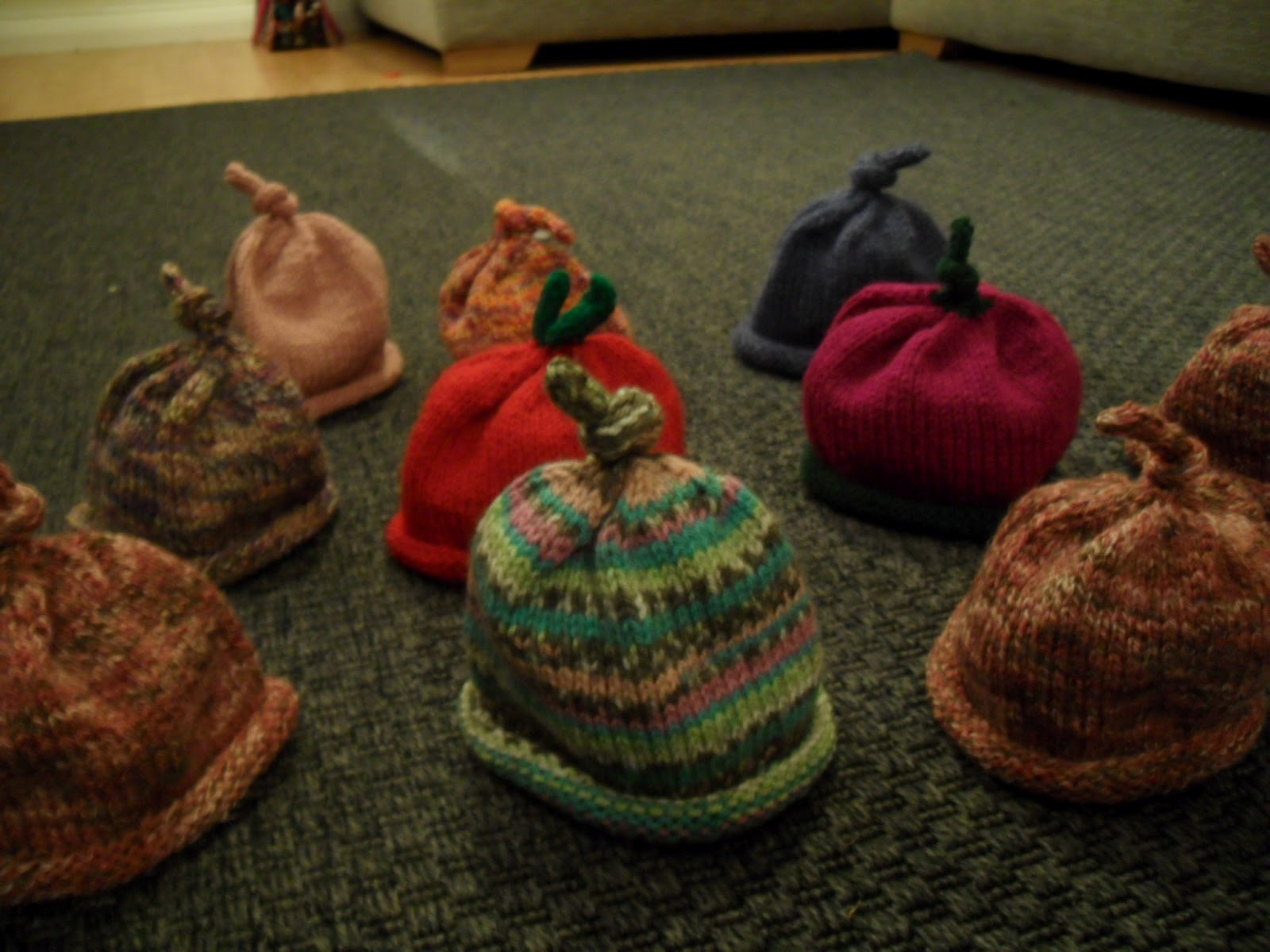
So I knit; I've knitted bags, flowers, tea cosies, scarf's, animals to name a few.  But mostly, I knit baby hats; these are simple, require no pattern, and are a gorgeous gift to give to the new mother for her new baby who has arrived earth-side.

Hats!

Tomato Hat


So I urge you fellow midwives, student midwives and aspiring midwives to take up your needles and start a (quiet) revolution.

Knitting is very conducive to thought.  It is nice to knit a while, put down the needles, write a while, then take up the sock again.  ~Dorothy Day

Happy knitting!

Midwife angela